
Data Center Basics
What are Data Centers?
Computers used to fill entire rooms. Today, most of us live our daily lives with more computing power in our pockets than NASA’s mission control had to put the first person on the moon. The computational power required to enable humanity’s greatest leap was not stored in the rocket that propelled astronauts into space; instead, room-sized computers hummed away in Houston, Texas, running live calculations and relaying that information across space and time to end users more than 238,000 miles away. This principle is still true today.
Much like NASA technicians communicating with astronauts in space, today’s tech companies manage high computing volumes in a single location, where time and cost efficiencies can be maximized in a controlled environment. When you press play on a video or order a package online, a remotely located server provides the computational power and data storage needed to deliver that service in real time. Without remote data storage, platforms like YouTube or Netflix might require you to download their entire libraries of content directly to your device to browse, which would be an unfeasible and inefficient option, especially if you only wanted to watch one or two videos out of millions of options.
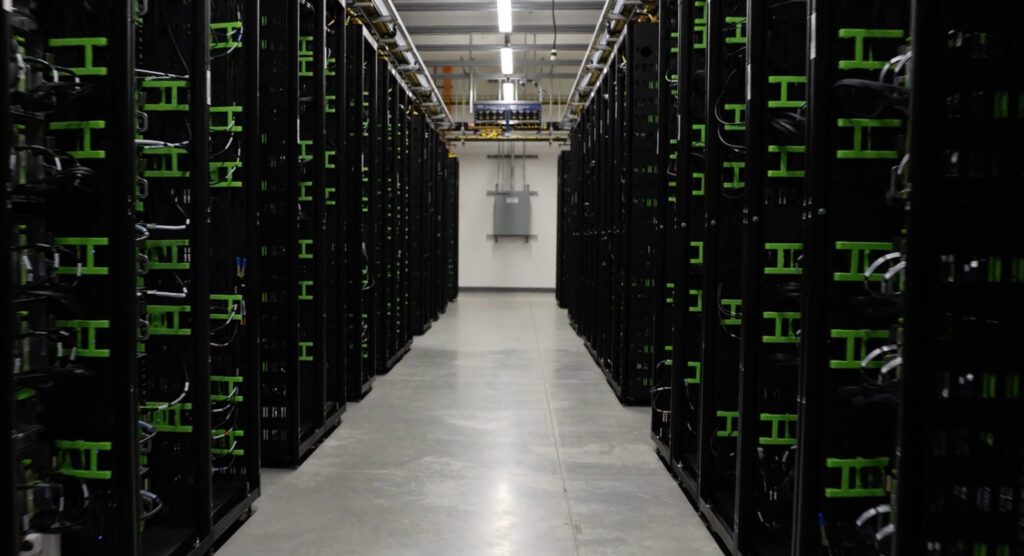
What do Data Centers look like?
Data centers are the physical facilities where this computational power and data storage infrastructure are concentrated. Most data centers look like warehouses. Some have outdoor equipment like power generators or HVAC units. New Albany zoning requires screening for most of this equipment behind walls and/or landscaping. The interior of most data centers consists of a front office and other employee amenities, followed by a wide-open room with racks of computer servers. Usually, these racks are configured like the shelves in a grocery store, so technicians can move among the aisles to service wiring or server equipment. Sometimes these components are in large drawers that pull out of the racks for easy maintenance.
Frequently Asked Questions
Are there different types of data centers?
Most data centers look and function the same, but industry experts frequently categorize data center companies based on one of three business models:
Enterprise
Enterprise data centers are data center facilities built and operated by the end user. For example, in New Albany, Discover Financial Services (DFS) owns and operates its own data center that exclusively serves DFS customers and business operations. This business model is usually used by established companies with very specific security, efficiency, or location-based needs.
Colocation
Colocation data centers offer data center rack space for lease to multiple tenants. Depending on the contractual arrangement between the data center company and the end user, the end user may furnish their own server equipment, or the data center operator may provide equipment to meet the customer’s needs. This business model offers scalability and the flexibility of paying for data center space on an as-needed basis. Quality Technology Services (QTS) is one of several colocation data center providers in New Albany.
Hyperscalers
Hyperscaler data centers own and operate large-scale data center infrastructure with an eye toward scaling at pace with new technologies or to serve other, fast-growing companies. Hyperscaler data centers are often the most dynamic of the three categories as they compete with one another to offer the latest and most efficient technology for their customers. Hyperscalers serve either their own businesses or others; the business model relies on offering speed to market for the world’s largest data center customers.
For example, suppose a large video streaming service does not wish to assume responsibility for the capital expenses required to update the equipment in an enterprise data center of its own, but has a data load that is too large for a colocation facility. In this case, the video streaming service could engage a hyperscaler to host its data. Often, hyperscalers may have other key accounts in the same data center, the collective revenue from which justifies the rapid, sweeping, constant upgrades to equipment in a way that one individual user could not. Generally, this leaves hyperscalers better positioned to compete at the cutting edge of the newest technology.
Amazon Web Services (AWS), Google, and Meta are examples of hyperscaler data centers in New Albany.
What is “Behind-the-Meter Natural Gas Power Generation?”
Any power generation that occurs on site, like rooftop solar, wind turbines, or backup power generators is considered “behind-the-meter” by utilities. These means of generation operate entirely independently from the grid.
Some data centers are turning to behind-the-meter power generation to increase power availability on site to align power generation with real-time demand and to alleviate stress on the consumer power grid. Data centers are predominantly turning to natural gas-fired turbines as an alternative behind-the-meter power source. Three natural gas power plants are currently under construction in the Licking County portion of the New Albany International Business Park.
The Ohio Power Siting Board (OPSB) governs major energy projects, generally those with generation capacities of 50 megawatts (MW) or more. The City does not have the authority to approve, deny, or otherwise determine whether these facilities are constructed. Decisions regarding the need for the facility, fuel type, capacity, and operation are made at the state level through the OPSB’s review and certification process. The City can encourage specific site layouts, buffering, and acoustic measures via the zoning process. Emissions and other environmental impacts are permitted under the Ohio EPA.
The energy infrastructure required to support hyperscale data centers in New Albany may generate a distinct and additive category of tax revenue. When owned and operated by a third-party provider, this infrastructure is taxed as Public Utility Tangible Personal Property (PUPP) at full millage rates. PUPP revenues are additive to the overall revenue mix and are not eligible for CRA abatement or TIF capture, ensuring they flow directly at full millage to schools, townships, and other local jurisdictions. The PUPP revenues generated from third-party power generation infrastructure represents the highest revenue generation per acre use in the history of the New Albany International Business Park.
Frequently Asked Questions
What has New Albany learned while working with data centers?
New Albany has learned many lessons that are mostly applicable to other local governments contemplating a data center project.
Ensure availability of inspectors and plan reviewers
Data center building plans often require industry-specific expertise to review efficiently. Upskilling existing City plan review staff or working to attract experienced talent is critical to working at the pace of the data center industry.
Create fee structures for building plan review and permitting
Given the complexity of data center building plans, there is a high possibility of repeated submissions and reviews. A reasonable fee structure is necessary to ensure that developers appropriately value staff hours and are prepared for every meeting.
Create a policy for fiber and wire installation in (or by establishing) utility corridors
Data center development brings redundant fiber infrastructure to public right of way. Other “prospectors” seeking opportunity along adjacent site frontage may apply to use the same right of way. Communities should prepare policies that prevent utility corridors from clogging with unreasonable or unending construction.
Collect company contacts to share with the public, media, and prospecting companies
Data center projects sometimes carry high public profiles. New Albany frequently receives questions or comments from the public that are more appropriate for direct communication with the company or construction contractor. It is important to have the right company contacts prepared to answer everything from media requests to business development cold calls.
Proactive communication with the public
Webpages like this one are important to keep members of the public informed, both inside and outside New Albany. A working understanding of data centers across the residential population enables higher level engagement in public meetings and enhances the quality of discussions with companies and City staff.
Site data center projects intentionally
Data centers generally employ fewer people than other commercial uses, making them a healthy addition to an already mature, job-dense region from a traffic standpoint. For example, more than 12 companies employ approximately 4,000 people in New Albany’s Personal Care and Beauty Campus near the geographic center of the New Albany International Business Park. The resulting daily traffic patterns in and around this area are manageable, but if all the adjacent land were to develop into similar advanced manufacturing uses, the existing five-lane roadways could be overwhelmed by commuter and logistics traffic at rush hour.
Preemptively negotiate development agreements that require behind-the-meter power generation infrastructure be owned by the third party rather than directly by the end user
When owned and operated by a third-party provider, this infrastructure is taxed as Public Utility Tangible Personal Property (PUPP) at full millage rates, establishing significant and consistent revenue streams for communities, schools, townships, and EMS services. Tangible personal property tax is not assessed when power generation infrastructure is owned and operated by the end user.